Sustainability
Building for the Future, Not at Its Expense
Duroholz is committed to a circular construction economy. We manufacture high-performance WPC doors by combining recycled wood fibres with advanced polymers creating door systems that actively reduce deforestation, eliminate toxic waste, and support India’s green building movement. Sustainability is not a marketing claim for us; it is an engineering principle embedded in every WPC door we produce.
Forest Conservation Through WPC Door Manufacturing
Every Duroholz WPC door installed directly reduces demand for natural timber logging. We source refined wood fibres from sustainable agricultural by-products not from harvested forests. For developers building 1,000+ unit townships, switching from timber to Duroholz WPC doors prevents the equivalent of hundreds of mature trees from being felled for door manufacturing alone.
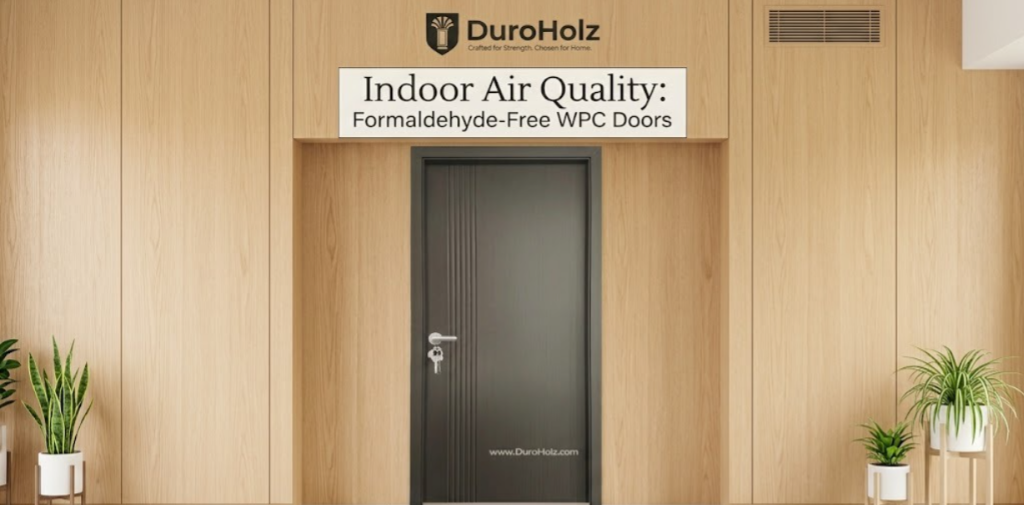
Indoor Air Quality: Formaldehyde-Free WPC Doors
Conventional plywood and MDF doors release formaldehyde a known carcinogen into indoor environments for years after installation. Every Duroholz WPC door is manufactured with zero UreaFormaldehyde resins, achieving E0-grade certification. Our low-VOC WPC doors are a prerequisite for buildings seeking IGBC, LEED, and GRIHA green building certifications across India.
100% Recyclable WPC Door Material
The Duroholz matrix combines refined wood fibres with high-grade polymers and performance additives to produce a high-density core ranging from 600 to 750 kg/m³ depending on the series. This density delivers the structural “heft,” acoustic mass, and satisfying tactile weight of solid hardwood doors while being 100% immune to termites, borers, and fungal decay. The homogeneous composition ensures consistent performance across every unit in a batch, unlike natural wood which varies grain-to-grain.
Longevity as a Carbon Reduction Strategy
The most sustainable door is the one you never need to replace. By engineering WPC doors that are immune to termites, rot, moisture, and UV degradation, Duroholz extends the door replacement cycle from 3–5 years (for timber) to 15–20+ years. This dramatically reduces the cumulative carbon footprint of manufacturing, transporting, and installing replacement doors over a building’s lifecycle.
Clean Manufacturing: Solar-Powered, Zero-Waste WPC Door Production
Modern buildings demand sophisticated hardware: digital locks, biometric access, RFID systems, automatic door closers, concealed hinges, and panic bars. All of these require a door core with exceptional screw-holding strength. Duroholz WPC doors are engineered to exceed 2,000N of fastener retention with the Timberra series exceeding 2,200N. This prevents the hardware loosening, stripping, and “frame-sag” that plagues conventional wooden and hollow-core doors, ensuring every handle, lock, and hinge remains perfectly functional for the entire life of the building.